What if you could turn every mailbox in your neighborhood into a $1,000 payday?
That’s exactly what Rachel and Dalton from Big Sky Automation have been doing with Every Door Direct Mail (EDDM) postcards.
Here’s the idea: the Postal Service lets you deliver a postcard to every home on a mail route for about $0.25 apiece.
You can use that to advertise your own business — or you can do what Rachel and Dalton do and sell that exposure to other local businesses.
By stacking multiple advertisers onto a single oversized postcard, they spread out the cost, create an affordable local advertising product, and keep the difference as profit.
They’ve mailed 20 postcards in about seven months, so this isn’t a one-off experiment. In this episode, they break down exactly how the model works — and why it keeps businesses coming back.
(Want to learn how to do this in your own area? Check out their free mini course at CommunityCardPlaybook.com)
Tune in to Episode 719 of the Side Hustle Show to learn:
- how the Every Door Direct Mail side hustle works
- how to sell it to local businesses
- how to make it repeatable and scalable
Sponsors
- Indeed – Start hiring NOW with a $75 sponsored job credit to upgrade your job post!

- Quo (formerly OpenPhone) — Try it for free!
- Shopify — Sign up for a $1 per month trial!

- Gusto — Get 3 months free of the leading payroll, benefits, and HR provider for modern small businesses!

How Every Door Direct Mail Works
Rachel and Dalton started with a larger postcard that went to 10,000 homes at a time. The cost for participating businesses was around $600 per mailing.
The problem became obvious fast: if direct mail works best with repetition, that price point made consistency unrealistic for most small businesses, especially if you’re mailing once or twice per month.
The fix wasn’t more volume. It was better targeting.
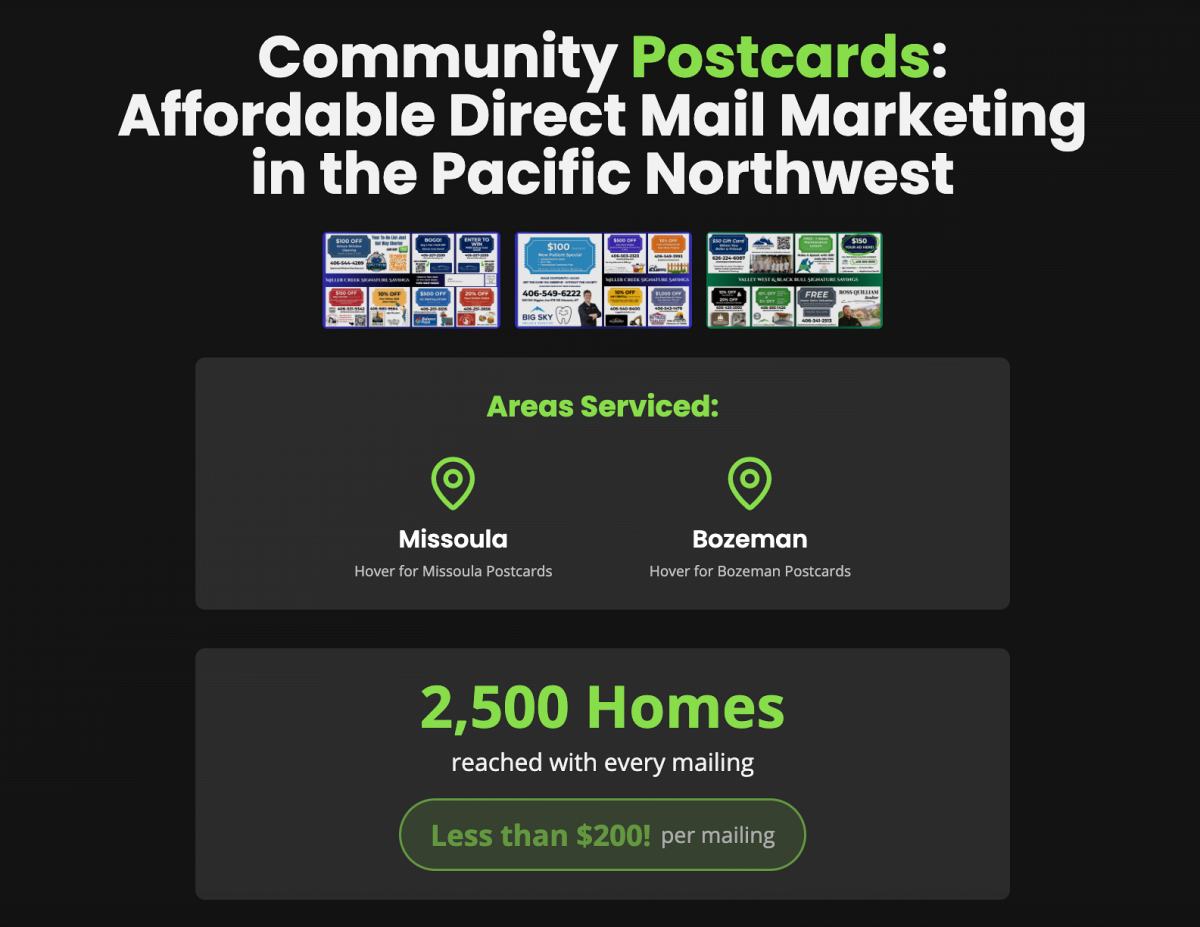
Instead of 10,000 homes, they focused on specific neighborhoods that local businesses already wanted to reach. Those neighborhoods averaged about 2,500 homes each. They typically mailed two neighborhoods per month.
The postcard itself shrank to 6.5 × 12 inches, with space for up to 16 businesses.
That single change dramatically reduced costs and made ongoing participation affordable. Businesses could now stay on the card month after month, which is where the model really starts to work.
Why This Is Different From Valpak
At a glance, this might sound like Valpak or Money Mailer. The differences matter.
Valpak envelopes often include 50–75 businesses, which makes it easy to get lost. They also allow direct competitors in the same envelope.
Rachel shared a story where she received a Valpak with two roofers back to back. She called one of them — and he switched to her postcard specifically because she guarantees category exclusivity.
That exclusivity is a huge selling point.
Solo direct mail campaigns can cost thousands per drop. Coupon envelopes are crowded. The community postcard sits right in the middle: affordable, focused, and uncluttered.
How to Position the Offer
This postcard is indirect advertising — more like a billboard than a Facebook ad.
That framing is critical.
Some business owners get this kind of marketing, some don’t. But when you explain that they can get their name in thousands of local homes for $150 per mailing, the conversation stays open.
Once you explain it and frame it that way, it’s greatly appreciated. Then businesses can start to compete with the big guys in town and end up in people’s mailboxes.
Direct mail is one of the few advertising methods that is 100% localized.
Why Businesses Love This Model
There are a few reasons this offer resonates so well with local businesses:
- Affordable exposure: They get into thousands of homes without paying solo-mail prices.
- Hyperlocal targeting: You’re mailing to neighborhoods they actually serve.
- Category exclusivity: No competitors fighting for attention on the same card.
- Credibility by association: Showing up alongside other local businesses increases trust.
How to Find Your First Advertisers
Instead of cold calling all day, Rachel and Dalton focus on low-pressure outreach:
- Facebook Messenger to business pages
- Email follow-ups
- Phone calls only after interest is shown
Their reasoning is simple: decision-makers are busy. Messaging lets them respond on their own time.
Facebook works especially well because business owners can quickly check out their page, see past postcards, and confirm they’re real people doing real mailings.
Rachel’s initial message is short and direct:
“Hey, I’m Rachel. I own Big Sky Automation Services. We’re sending out a postcard to 2,500 homes in Miller Creek. Spots start at $150 — would you be interested?”
Including the price upfront qualifies leads and increases response rates.
How to Get Started with EDDM
You can use the USPS Every Door Direct Mail tool to target specific areas.
You can click on different areas you want to get to. It’ll show you the income in that area and the age demographics.
You want to target around 2,500 total mailers. The USPS site will show you the approximate cost for postage. For a 2,700-home mailing, the postage cost would be around $680.
From there, you want to fill that up with advertisers. If you sell 15 spots at $150 each, you’ve got $2,250 in revenue. After you subtract the $1,300 in total costs for printing, postage, and fulfillment, you’re left with around $1,000 in profit.
The Best Businesses to Target for EDDM
Over time, patterns emerged around which advertisers stick around.
Consistent performers include:
- Dentists
- HVAC companies
- Roofers and plumbers
- Other high-margin home service businesses
- Body contouring and weight-loss services
- Restaurants and coffee shops
Restaurants are especially valuable because they make the card “sticky.” When people see a food offer, they’re more likely to keep the postcard, which benefits every advertiser on it.
Home service businesses tend to understand the model well. They don’t need customers every day, but when the need arises, they want to be the first call.
The Profit Math
Here’s how one postcard typically breaks down:
- 16 advertisers × $150 = $2,400 revenue
- Printing, postage, and fulfillment = $1,300
- Profit per mailing = $1,100
There’s no upfront cash risk because advertisers pay before anything is printed. In higher-priced markets, margins can be even better.
Design and Fulfillment (Without Touching Postcards)
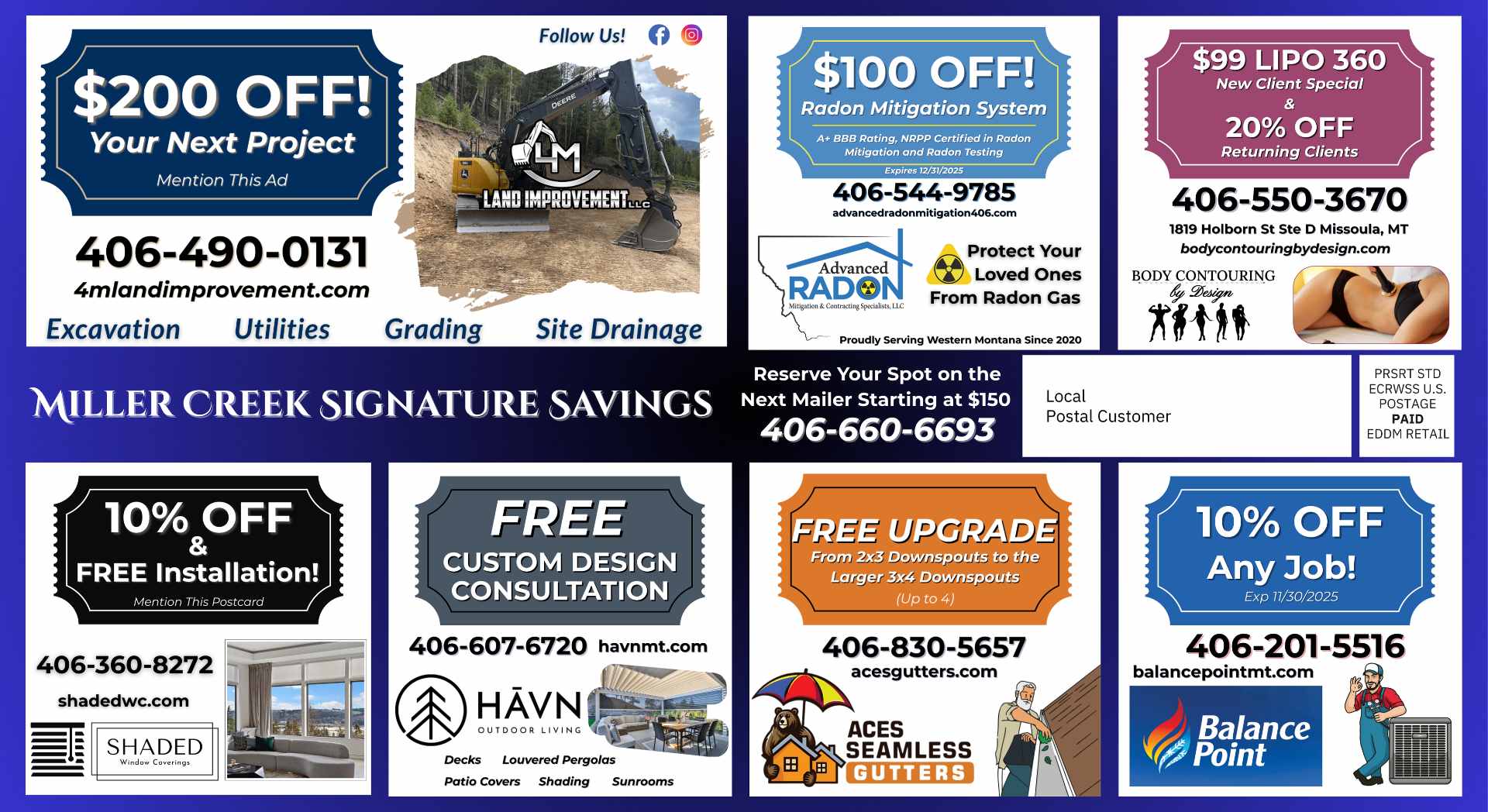
Design is handled in Canva using simple templates. Most businesses prefer Rachel and Dalton to design their section, which keeps the card clean and consistent.
They avoid clutter. Many ads are just a logo, short offer, and phone number.
For fulfillment, their printer (EDDM-friendly printers such as GotPrint or Taradel):
- handles EDDM bundling
- prepares facing slips
- ships directly to the post office
The printer is based in New York and ships postcards to Montana within days. Rachel and Dalton rarely touch the mailers themselves.
Building Retention and Recurring Revenue
From May through December, Rachel and Dalton mailed 20 postcards to the same two neighborhoods and maintained a 60–70% retention rate.
The reason was expectation-setting.
This works best with multiple touches. One postcard isn’t a magic bullet.
Today, they primarily sell 3–6 month packages, paid upfront. That creates predictable revenue and reduces the need to resell every month.
Expanding to New Areas
Once the system works, expansion is straightforward.
Rachel and Dalton ran postcards in Bozeman, Montana — four hours away — without ever visiting in person. Outreach, sales, and coordination all happened remotely.
In more densely populated areas, new neighborhoods might be just a short drive away, opening up even more opportunities.
Using the Card as a Foot-in-the-Door
For Rachel and Dalton, the postcard isn’t just a side hustle. It’s a relationship builder.
Once trust is established, conversations naturally expand into:
- website improvements
- reputation management
- Google Business Profile optimization (are you responding to Google Reviews?)
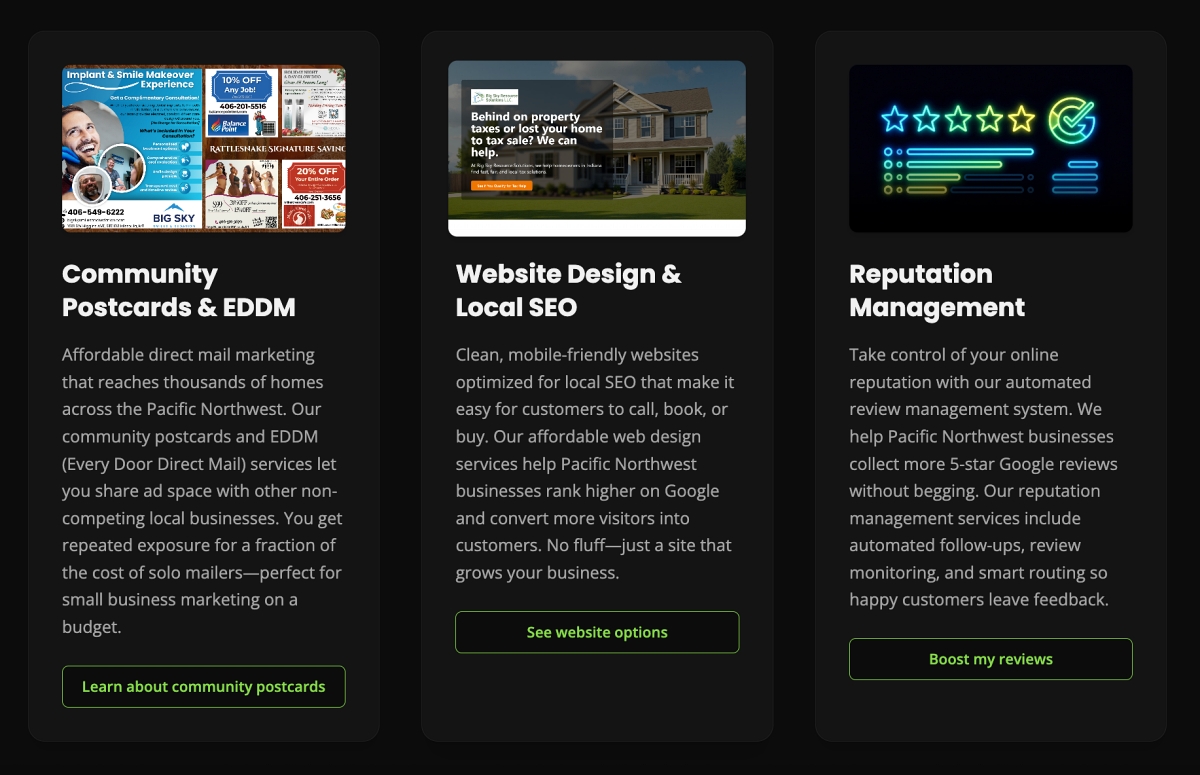
Each postcard creates up to 16 warm business relationships.
In one example, a brewery owner advertised his own business on the card while other advertisers covered the cost — effectively marketing for free.
The Biggest Mistake to Avoid
Their biggest early mistake was over-promising results.
Direct mail benchmarks often focus on direct response, but this model is about awareness and repetition.
Businesses can’t expect to spend $150 once and land a $4,000 job. It can happen, but it’s not the expectation to set.
Clarifying that upfront dramatically improved retention.
What’s Next for Rachel and Dalton?
Rachel and Dalton are now testing another shared advertising model: physical community boards placed inside restaurants, gyms, and other local venues.
Each board:
- stays up for a full year
- features fewer advertisers
- delivers constant exposure to foot traffic
It’s another way shared advertising can produce strong margins without large upfront costs.
Rachel and Dalton’s #1 Tip for Side Hustle Nation
Rachel: “Don’t wait to start.”
Dalton: “You have to be consistent. You have to be disciplined with your consistency because your motivation will run out.”
Episode Links
- Big Sky Automation
- CommunityCardPlaybook.com
- USPS Every Door Direct Mail tool
- Canva
- GotPrint
- Taradel
Looking for More Side Hustle Help?
- Download The Side Hustle Show. My free podcast shares hundreds of side hustle ideas to make extra money.
- Start Your Free $500 Challenge. My free 5-day email course shows you how to add $500 to your bottom line.
- Join the free Side Hustle Nation Community. The free Facebook group is the best place to connect with other side hustlers and get your questions answered.
The award-winning Side Hustle Show is the #1 side hustle podcast
with over 1,300 5-star ratings!

Listen in your favorite podcast app or directly in your browser.