
What does it actually take to build a $250,000 a year independent income stream, and how long will it really take you to get there?
Adriana Tica is a self-described reluctant entrepreneur who now runs two digital marketing and copywriting agencies, works as a strategic marketing consultant, and publishes the Strategic AF newsletter.
She put hard data behind questions most solopreneurs quietly wonder about with her research report, the State of Solopreneurship.
We talked about what the report actually found — from how long it takes to hit six figures, to why email still beats everything else, to the lead magnet and newsletter growth tactics working best right now.
Tune in to Episode 724 of the Side Hustle Show to learn:
- the most common revenue path for 6-figure solopreneurs
- how to validate a digital product idea before you build it
- the newsletter growth strategy that works better than a free download
Sponsors
- Indeed – Start hiring NOW with a $75 sponsored job credit to upgrade your job post!

- Quo (formerly OpenPhone) — Try it for free!
- Shopify — Sign up for a $1 per month trial!

- Gusto — Get 3 months free of the leading payroll, benefits, and HR provider for modern small businesses!

Round 1: The State of Solopreneurship Report
Owned Channels vs. Borrowed Channels
Adriana opens with one of the core frameworks from her report: the difference between owned and borrowed channels. A borrowed channel is anything where an algorithm controls who sees your content:
Think:
- TikTok
An owned channel gives you direct access to your audience without that algorithmic middleman, most commonly:
- podcast
- private community
We’re now in what she calls the “interest graph era,” where platforms serve content based on what they think you want, not necessarily from the people you actually follow. That means even your existing followers may never see your posts.
The report’s most telling finding: even though 36% of respondents said LinkedIn was their primary revenue driver today, the vast majority said they planned to double down on owned platforms like email, communities, and podcasting in the future.
Adriana sees this as a sign of maturity. Solopreneurs are learning not to build their whole business on someone else’s land.
Why LinkedIn Drives Revenue But Why Solopreneurs Are Diversifying
The LinkedIn skew makes sense given the cohort: most respondents were in B2B, and LinkedIn is where business buyers expect to find business content.
When people’s expectations are met on a platform, they’re more likely to buy. Compare that to seeing a hard-pitch post in the middle of your TikTok feed — that cognitive dissonance makes people less likely to act.
B2B also tends to be more profitable than B2C, even though sales cycles are longer. A corporate workshop, for example, will command a higher price than the same content sold to individual consumers.
For Adriana personally, email is the clearest winner: over 80% of her clients tell her they found her on social media but bought because of her emails.
The Attention Loop (Not a Funnel)
Adriana pushes back on the idea that the customer journey is a straight line.
In reality, the cycle is:
- most people discover you
- forget about you
- rediscover you months later
- subscribe to your email
- and then take months or years more before they actually buy.
She calls this an “attention loop” rather than a funnel.
This is exactly why so many creators work hard to move people off social media and onto their email list — not out of distrust of the platform, but because it creates a channel where the relationship can deepen at your own pace, not the algorithm’s.
Tools like ManyChat have made this easier by automating the handoff: post a comment keyword, get the link delivered automatically, land on the opt-in page.
Her Personalized Welcome Email Sequence
When a new subscriber joins Adriana’s list, the first email has the subject line: “Welcome! Can I send you a free gift?”
Inside, she asks one question: what’s your biggest challenge?
Based on which of three options they choose, they’re automatically sent a tailored sequence of resources, plus soft pitches for paid products that solve that specific challenge.
She’s not a fan of long, aggressive sales sequences. Her goal is for subscribers to understand what she sells through her regular weekly emails and let them buy in their own time.
How Long Does It Really Take to Reach $100k?
If you’re less than 3 years into your solopreneur journey, making over $100,000 is very rare. Almost everyone making $250,000 or more was well past that three-year mark.
Adriana started this research because she was frustrated by survivorship bias: the “six figures in three months” stories that dominate social media, while ignoring the many businesses that struggled or failed quietly.
As she puts it: “Business is hard. It’s supposed to be hard.”
This reminded of the 1000-Day Principle from the Tropical MBA podcast — the idea that it takes roughly three years to replace your day job income starting from scratch.
Adriana’s data backs it up. The common thread for people who hit six figures faster: they were launching a second business, using leverage they’d already built.
The Most Common Ways Solopreneurs Make Money
The dream of passive income is real, but the data shows the top two monetization methods are still service-based: 1:1 consulting and advisory (65% of respondents) and done-for-you agency work (41%). Digital products, cohort courses, and self-paced courses make the list but trail behind significantly.
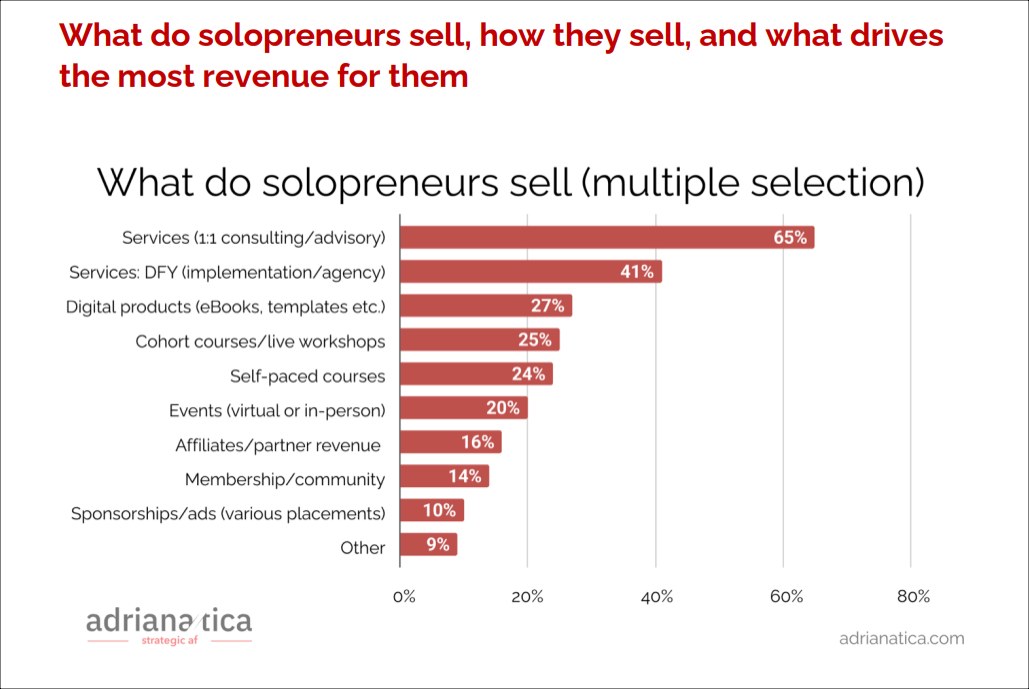
The reason services dominate is straightforward: people will always pay more for someone to take a problem off their plate than to teach them how to solve it themselves. And you don’t need a massive audience to make services work… you just need the right clients.
There’s an underrated benefit to starting with services, too: your clients will tell you exactly what products to build next.
Adriana now builds products by watching which email topics get the most replies, asking subscribers whether they’d buy something, and building a waitlist before committing to full development.
How to Validate a Product Before You Build It
Adriana’s preferred launch method: sell the idea as a live, paid workshop first. Her first course, Audience Accelerator, which teaches how to build an audience that actually buys from you, started this way.
She set a goal of at least 10 buyers to confirm demand. She got 15. The live workshop was priced around $100, and she later re-recorded it as a fuller on-demand course at $200, which is still selling two years later.
These days, she prices the live version higher than the recorded version, since it includes live Q&A and direct interaction.
She skips pre-sales — she’d rather build a waitlist, communicate with that group more frequently, and launch when ready. For solopreneurs with an established audience, she recommends showing confidence in your idea rather than outsourcing validation to your audience’s wallets.
Email List Size vs. Revenue: The Surprising Finding
Here’s something counterintuitive from the data: most had under 500 email subscribers, and roughly two-thirds had under 10,000. And yet many were generating real revenue.
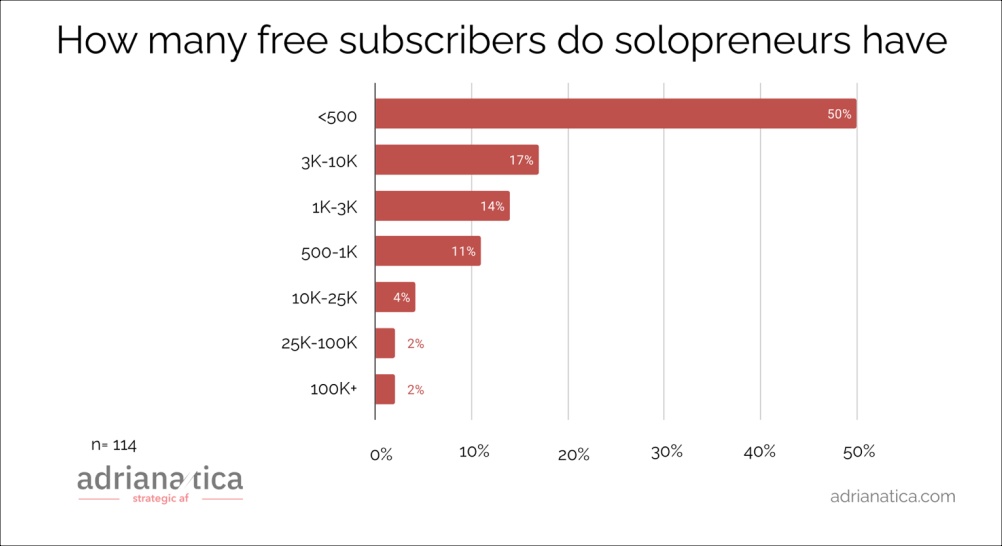
The explanation: when you sell services at premium rates, you don’t need a large audience. You need the right one.
A highly targeted list of a few hundred engaged subscribers can sustain a thriving service business.
You’d need an audience of 10k to 100k or more to make a real living from sponsorships or low-ticket digital products alone.
Lead Magnets vs. Subscribing for Your Thinking
Adriana draws a clear line between two types of list-growth strategies.
A strong lead magnet (a free download, checklist, or template) gets you volume. But many of those subscribers will grab the freebie and unsubscribe. People who sign up specifically to follow your thinking are far more likely to eventually buy.
Her take: if you want depth and buyers, get people to subscribe for your point of view, not a PDF.
That said, paid or free workshops are one of the highest-quality lead magnets she’s seeing work right now, especially for service businesses, because they attract people who are already action-oriented.
Where Solopreneurs Are Investing Time in 2026
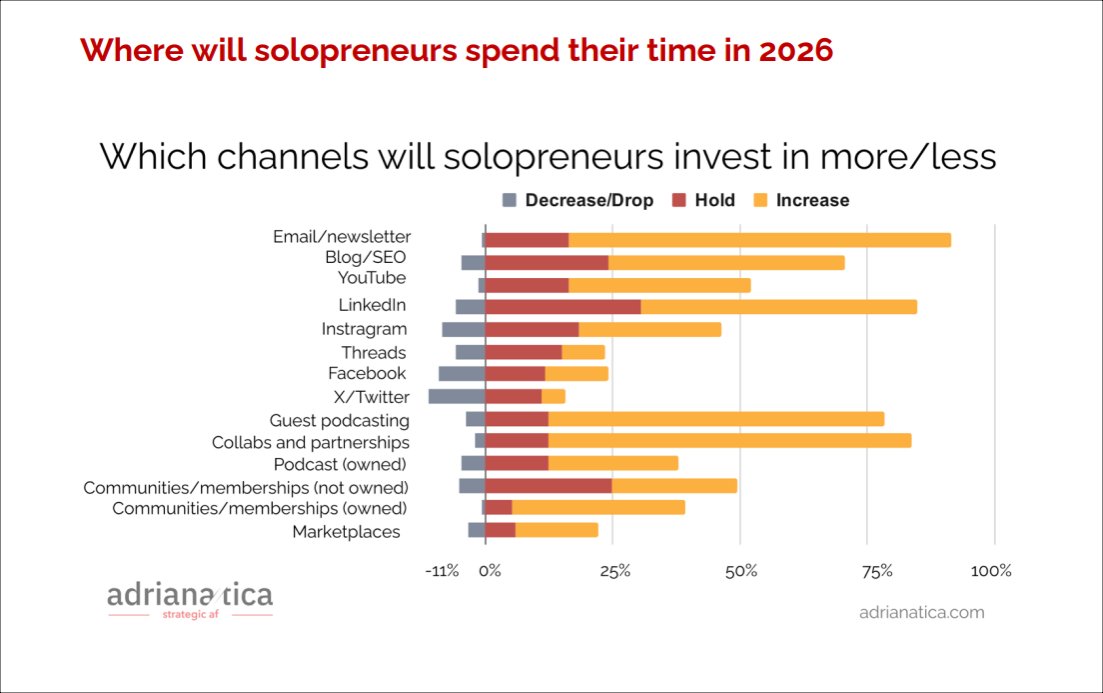
The report’s forward-looking section asked respondents where they planned to spend more or less time going forward. Email and newsletter topped the list for planned increases — no surprise there. But a few findings stood out:
- Guest podcasting and collabs/partnerships ranked high for planned increases (reflecting the trend toward relationship-based growth.)
- Blog and SEO showed a split reaction – some increasing, some decreasing (which Adriana connects to the broader rediscovery of long-form content.)
- Very few respondents planned to reduce their YouTube investment – because it functions both as a search engine and a long-form relationship builder. X/Twitter showed the most planned reductions.
Adriana also sees a trend toward what she calls a “blog capsule,” a curated set of articles a business can send to any new lead or client.
Something they can sit down with over coffee and really understand who you are and how you work. It’s the kind of depth that’s simply impossible to build in a 30-second video.
(You can find the full State of Solopreneurship report at adrianatica.com/state-of-solopreneurship.)
Round 2: Business Idea Donation – An Internet Anthropology Newsletter
Adriana’s business idea donation for Side Hustle Nation is a newsletter built around internet anthropology.
This is about researching and explaining:
- how internet trends came to be
- how creators rose to fame
- and how brief viral moments connect to longer cultural shifts
She points out that the mommy bloggers of the early internet played a foundational role in shaping the creator economy we know today, and very few people have traced that history.
Outside of Taylor Lorenz, she doesn’t know anyone going all in on this at a broad level. Chenell Basilio’s Growth in Reverse is a related example — in-depth case studies of how specific creators grew, each often requiring 25+ hours of research.
Adriana’s approach: go broad rather than person-by-person. Cover trends, creator categories, and the historical arc of the internet as an industry.
The content could live behind a paywall, or use a Substack-style support model — asking readers to pay what they want with no extra content promised in return, similar to how Dan Carlin funds Hardcore History.
Monetization over time could include advertising, affiliate partnerships, or consulting for brands interested in trend analysis and forecasting.
Round 3: The Triple Threat
Marketing Tactic: Newsletter Cross-Promos and Partnerships
Adriana’s top working marketing tactic right now is peer cross-promotions: trading newsletter mentions, lead magnet recommendations, and audience introductions with other creators who serve a similar audience.
She’s deliberate about it: she always reads and tests whatever she plans to recommend before sending it to her list. She sets terms upfront with partners, tracks results (sometimes sharing click data), and finds her best partners in private communities, where there’s already some built-in vetting.
Her audience has learned that if she recommends something, it’s worth checking out — and she’s not willing to risk that trust.
The tradeoff: it doesn’t scale easily. Every swap requires relationship-building and vetting. But the depth of audience fit beats almost any other channel she’s tried.
Favorite Tool: Circle
Adriana recently launched her own community, called The Council, on Circle. She was already a Circle user before becoming an administrator, so the choice was easy.
She describes it as complex but intuitive — reminiscent of early Facebook, with a well-organized:
- forum
- spaces for every topic or event
- API integrations
- affiliate programs
- built-in course hosting with paywalls
- and more
She notes the video streaming feature wasn’t great when she first tried it. Circle works for both free and paid communities, but it’s not cheap, especially as member count and feature usage grow.
Favorite Book: Content Simplified
Her favorite book from the past 12 months is Content, Simplified by Lee Densmer.
She describes it as a practical manual for building a successful content program — a must-read for anyone in marketing or content creation.
What’s Next for Adriana?
Adriana is focused on growing The Council, her recently launched community on Circle, which opened in late December.
Starting at $500 per year, it’s designed as a place to actually implement strategy, not just learn about it. The first initiative is a four-week newsletter growth bootcamp built around live calls, homework, and community-based partnership swaps.
Episode Links
- AdrianaTica.com
- Strategic AF Newsletter
- State of Solopreneurship Report
- The Council (Adriana’s Community on Circle)
- Circle
- Content, Simplified by Lee Densmer
- Growth in Reverse – Chenell Basilio
- Tropical MBA Podcast
- ManyChat
Looking for More Side Hustle Help?
- Download The Side Hustle Show. My free podcast shares hundreds of side hustle ideas to make extra money.
- Start Your Free $500 Challenge. My free 5-day email course shows you how to add $500 to your bottom line.
- Join the free Side Hustle Nation Community. The free Facebook group is the best place to connect with other side hustlers and get your questions answered.
The award-winning Side Hustle Show is the #1 side hustle podcast
with over 1,300 5-star ratings!

Listen in your favorite podcast app or directly in your browser.