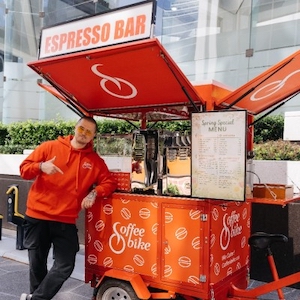
Want to start a mobile coffee business without the overhead of a brick-and-mortar café?
Vlad Priadko didn’t want to sign a lease, hire a staff, or take on the overhead of a coffee shop. He wanted the margins on coffee without the building.
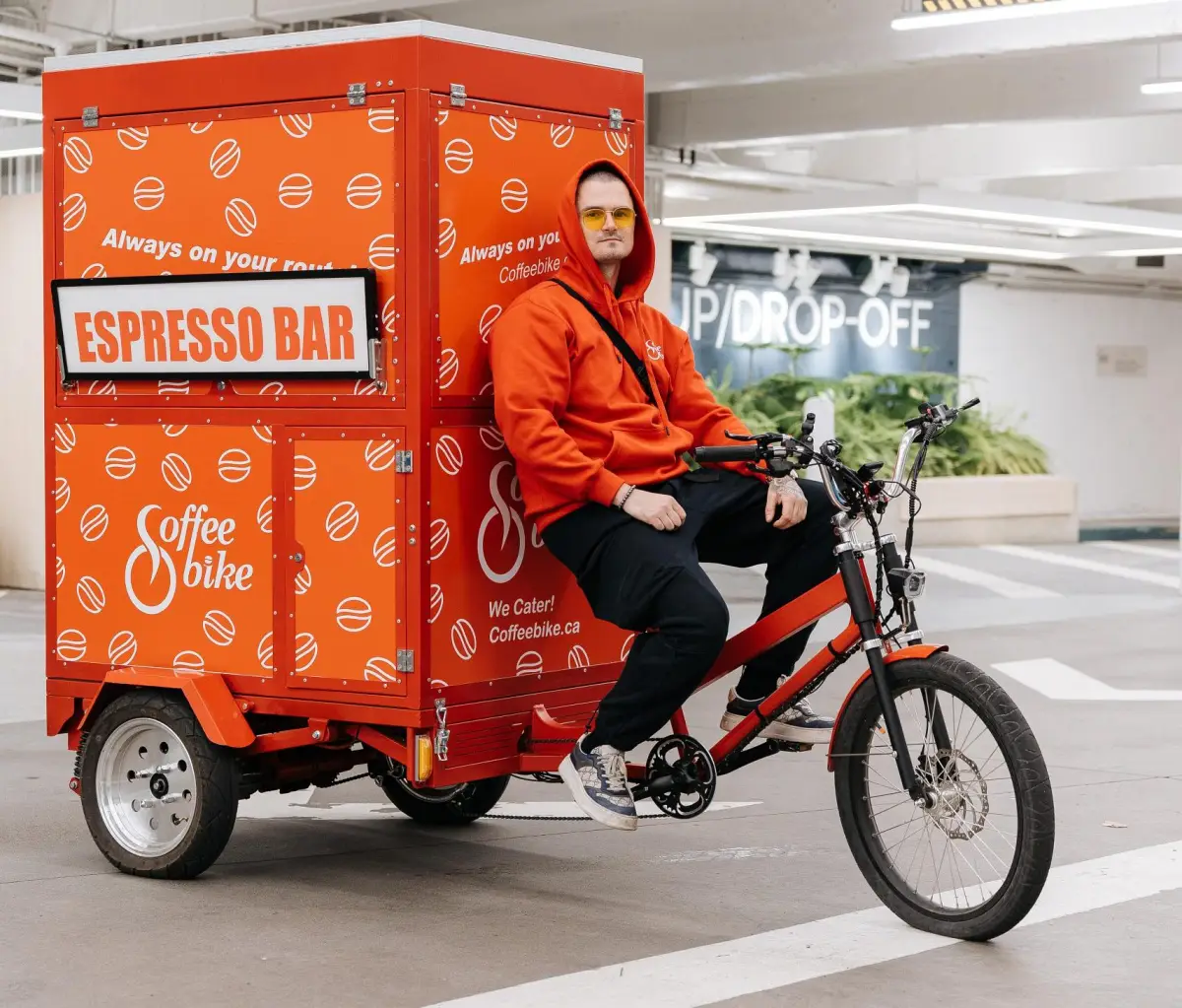
So he built a coffee bike instead — an espresso setup mounted on an electric-assist cargo trike — and started riding it to the people.
Eight years later, Coffee Bike has sold more than 1 million cups of coffee and generated over $3 million in revenue.
Vlad has also built and sold 42 units to other entrepreneurs, and pitched the concept on Dragon’s Den.
Tune in to Episode 754 of the Side Hustle Show to learn:
- how a mobile coffee business actually makes money
- which events are the most profitable to serve
- how to find your first paying customers
Sponsors
- Quo (formerly OpenPhone) — Try it for free!
- Shopify — Sign up for a $1 per month trial!

- Gusto — Get 3 months free of the leading payroll, benefits, and HR provider for modern small businesses!

- Indeed – Start hiring NOW with a $75 sponsored job credit to upgrade your job post!

- Monarch — Get an extended 30-day free trial!
How Vlad’s Mobile Coffee Business Got Started
Vlad didn’t even drink coffee when he came up with the idea. He looked at the numbers instead.
A cup sold for about $5 and cost him about $1 in ingredients. Going mobile cut out nearly all the overhead, which put his margin as a solo operator in the 70-80% range — against 5-20% for a typical retail coffee shop.
So at 21, he ordered a cart from overseas without checking local rules.
The health department told him there was no way it would get approved, and it took a year of YouTube research and conversations with handymen to finally pass inspection.
The cart worked. It just wasn’t scalable.
Note: In Vancouver, his coffee bike requirements are similar to food truck’s. In the US, some counties treat smaller carts as their own category with lighter requirements. Either way, call your local health department first!
Turning the Cart Into a Coffee Bike
The approved cart was heavy, and the weight sat out in front of the rider. It blocked his view and made hills nearly impossible.
Setup alone took two hours every morning, hauling the espresso machine from his car to the cart piece by piece.
But after two to three months serving customers in Vancouver, Vlad had his answer. People loved it. The concept was right — the execution wasn’t.
Then he noticed the delivery trikes riding around the city, with a big cargo box behind the rider instead of in front. He sketched one in a notebook and tried to fit all his coffee equipment into that box.
That flip is where the coffee bike came from.
What It Costs to Start
If you want to put something together yourself, Vlad said you can work with a budget of around $10,000.
It won’t be perfect and you’ll be starting with a low-end espresso machine, but you can build something that works.
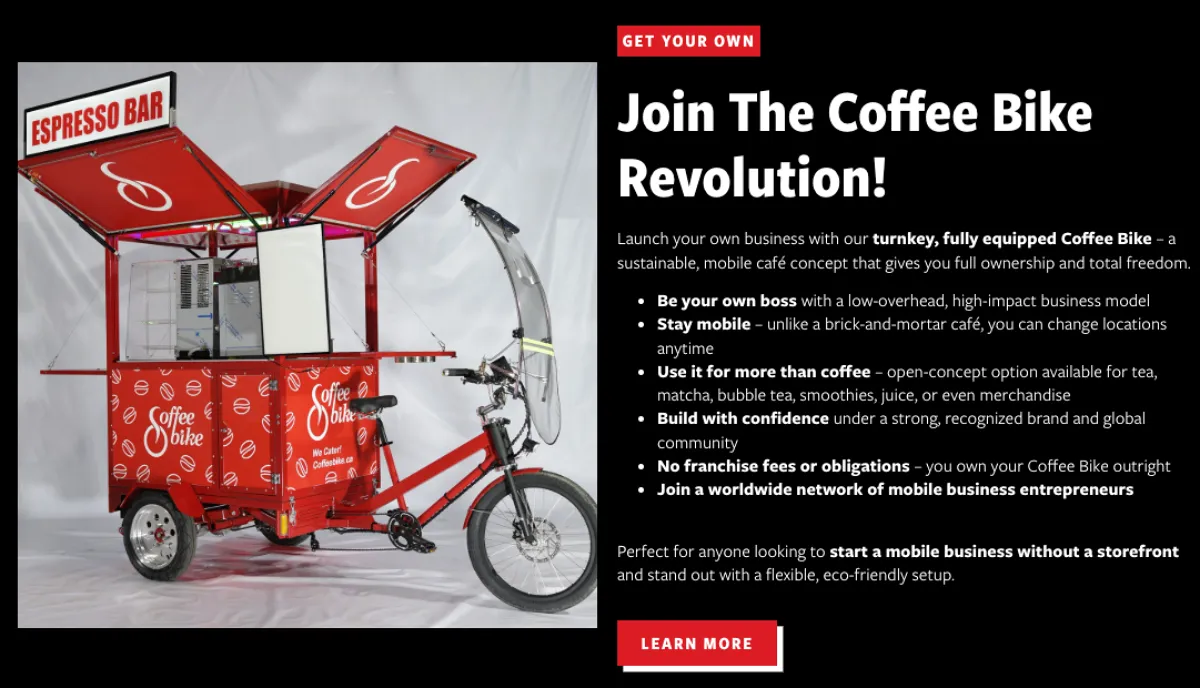
For comparison, the bikes he now manufactures represent $20,000 to $25,000 worth of equipment. That gap is part of what he charges for at events.
Why Location Beats Foot Traffic
Vlad built his first unit for one specific location he was sure would work. It was a disaster.
The spot sat between a subway and a bus station — thousands of people crossing every few hours, all of them in a rush. Nobody wanted to stop between connections.
He put up a handwritten sign that said “slow down, enjoy the cup of coffee.” It didn’t matter.
So he moved two blocks, to the next subway station, where people were coming out and heading to their offices.
Sales went up 5x.
“Whatever you’re gonna plan before making a commitment, most likely the real life gonna be completely different.”
How to Build a Regular Office Route
Once Vlad found the right neighborhood, he walked into about 10 offices and pitched a schedule:
- Office 1 – 10 to 11
- Office 2 – 11 to 12
- Office 3 – 12 to 1
- Mondays, Wednesdays, and Fridays only
That limited window created scarcity, and people got excited when he showed up.
Getting in was simple: be nice to the first person you see, then work out who’s in charge. Usually, it was the reception desk, and she’d blast the office Slack or Discord to let everyone know the coffee guy was coming.
He also spent his evenings hunting contacts through LinkedIn and Facebook.
And don’t forget to post your weekly schedule and daily location to your stories. It’s the cheapest way to build a customer base that keeps coming back.
What a Coffee Route Actually Pays
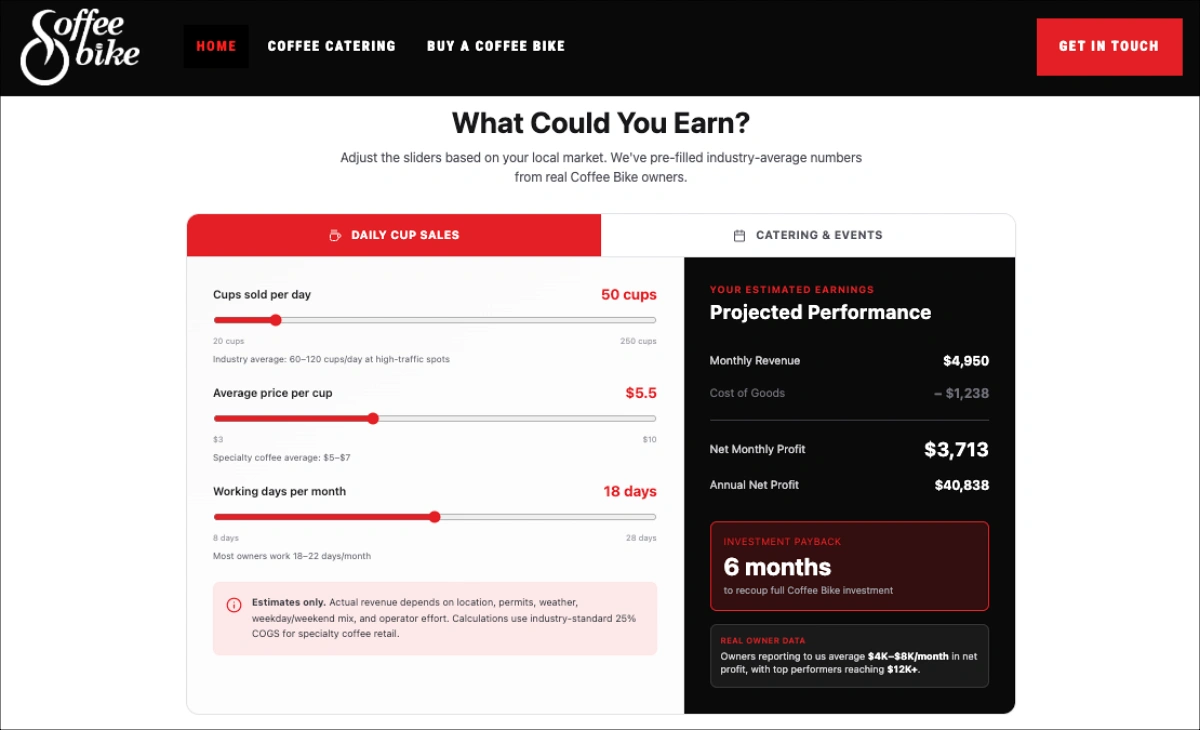
Vlad’s office run brought in about $150 per office, or roughly $450 to $500 per day across three stops.
That’s four to five hours of work, so call it about $100 an hour in sales — and he described that as a relatively slow pace. In a high-volume environment, a single bike can do up to $300 an hour.
After paying for beans, cups, and milk, a solo operator pockets around $70 an hour in profit. A barista working in a coffee shop makes closer to $15 or $20.
Do You Need Barista Experience?
Not much.
Before he touched a coffee machine, Vlad took a two-week course at a barista academy in Vancouver.
That gave him the basics — what a latte is, what a cappuccino is, how to steam milk, the difference between arabica and robusta beans.
How Private Events Became the Biggest Revenue Stream
Recognition from the office routes led to event invitations, and events now make up more than half of Vlad’s Vancouver revenue.
He charges $275 an hour for the experience, not per cup. One unit realistically serves about 50 cups an hour, so that’s roughly $5.50 a drink at full capacity, plus a delivery fee based on distance. Margins run 70% to 95%.
One VIP booking: five hours, $1,500, about 10 guests. They took maybe 30 drinks, costing him $30. Nearly all profit.
The range of events is wide:
- Bridal and baby showers – around 25 people
- Birthday parties – around 100
- Weddings – around 200
- Rock festivals – up to 5,000, where he brings four bikes and serves for eight hours
The Branded Event Contracts
Two or three times a year, a large brand pays to fully custom-wrap the coffee bikes in their own branding and give out free drinks in a space they pick. Those are prepaid and reach high six figures.
He’s done it with large AI companies and, recently, DoorDash.
For that one the bikes weren’t even serving coffee — they were wrapped in DoorDash branding and handing out FIFA merch. The marketing team just wanted the bikes.
They still paid him the coffee rate, since that was his opportunity cost. All of it from a business that costs about $20,000 to start.
Scaling to 10 Units and a Manufacturing Business
Vlad now runs four coffee bikes in Vancouver, down from a peak of eight, plus six smaller espresso bars for tighter spaces. That’s 10 units and a team of baristas.
But the bigger pivot was realizing he could sell the setup itself. Once he knew how to build the bikes, he started manufacturing them for aspiring entrepreneurs in other cities — a business-in-a-box version of what he’d built.
To date, he’s built 42 units across 28 owners.
He calls it Coffee Bike World, and it’s deliberately not a franchise:
- No royalty, no marketing fee
- Owners control their own logo, colors, menu, and prices
- Full ownership of the unit
- Optional upsells only — his beans, custom cups, website help
- No territory contracts, just a gentleman’s agreement not to overlap
The long game is scale. With hundreds of owners, only a fraction need to buy anything for the recurring revenue to work.
What Happened on Dragon’s Den

Vlad grew up watching Dragon’s Den and Shark Tank, but never thought a local coffee cart was investable. What would he offer — a share of his park sales?
Manufacturing changed that. Once he was selling the concept to entrepreneurs worldwide, he had a pitch.
He filled out a couple of online questionnaires, got invited to audition, and landed a spot on the show’s season 20 anniversary. He rented a bike from an owner near Toronto, put a temporary vinyl wrap on it, and rode it onto the set.
Then, he got an on-screen deal from Arlene Dickinson, who later ordered three coffee bikes for Balzac’s, her coffee brand.
But the deal never closed. Both of them felt it was early, and Vlad realized he didn’t want to report to someone on every idea.
Tools and Tech
- GoHighLevel – his CRM
- AI agents – cold lead outreach and pre-qualifying leads before they book a call
- ChatGPT and Claude – he rebuilt his website with Claude Code
- Instagram and Facebook ads – $3,000 to $5,000 per month
- Starlink – how he works from his car
The volume behind it is real. Vlad made more than 15,000 calls himself last year, and more than 5,000 people have left an inquiry on his site.
He estimated $50,000 in ad spend led to roughly 20 sales — $350,000 to $400,000 in hardware.
What Surprised Him Most?
Not a number. People.
Most are far more supportive and responsive than he expected. We make assumptions about someone before we’ve even spoken to them, but in his experience a lot of people are almost waiting for someone to talk to them.
His read is that we’ve lost some of our everyday socializing, and a coffee bike puts you right in the middle of it.
What’s Next for Vlad?
Vlad is finishing a cross-Canada trip on the coffee bike, five weeks in at the time of recording.
He’s towing a bike behind his car, has visited more than 50 cities, and plans to return to Vancouver by a different route to hit another 50. It’s all documented on YouTube at CoffeeBike TV.
After that, he’s moving to Asia for a year. He signed off his Vancouver apartment lease before the trip, and his wife and kids are already there waiting for him.
He wants to live up to the last word in Coffee Bike World.
There are units in Canada, the U.S., and one in Peru, with inquiries coming from Europe, Australia, New Zealand, and Asia — and his Vancouver team keeps things running while he’s away.
Vlad’s #1 Tip for Side Hustle Nation
“Just execute.”
Episode Links
- Coffee Bike
- CoffeeBike TV on YouTube
- Vlad on Dragon’s Den
- GoHighLevel
- ChatGPT
- Claude
- Starlink
- DoorDash
- Episode 744: $0 to $100K in Year One: How This Anti-Inflammatory Coffee Brand Did It, with Eli Mash
- Episode 651: How to Make Money on LinkedIn, with Joe McKay
- Episode 621: How to Make Money on YouTube with AI Video Tools, with Tony Lysandrides
- Episode 415: How to Start a Mobile Detailing Business: Zero to $6k a Month, with Josh Belk
- 20 Ways to Make Money on Facebook … without Selling Your Soul
Looking for More Side Hustle Help?
- Start Your Free $500 Challenge. My free 5-day email course shows you how to add $500 to your bottom line.
- Join the free Side Hustle Nation Community. The free Facebook group is the best place to connect with other side hustlers and get your questions answered.
- Download The Side Hustle Show. My free podcast shares how to make extra money with actionable weekly episodes.
The award-winning Side Hustle Show is the #1 side hustle podcast
with over 1,300 5-star ratings!

Listen in your favorite podcast app or directly in your browser.